Why Is There No S in Spelling Bee? The Rule Explained
Why the letter S almost never appears in Spelling Bee, what the editor said about it, the rare exceptions, and how the rule changes the words you can play.
Key takeaways
- Spelling Bee leaves out S so players can't double the word list with plurals.
- The NYT editor confirmed the rule in 2021; only a few one-off exceptions exist.
- No S also removes -NESS, -LESS, DIS- and MIS- words.
- Use -ED, -ING and -ER instead of reaching for S.
If you play Spelling Bee often, you’ll notice something missing: the letter S. It’s one of the most common letters in English, yet it almost never shows up in the hive. Here’s why.
The short answer: plurals
If S were allowed, almost every noun could be turned into a second answer just by adding it: TRAIN and TRAINS, PAINT and PAINTS. The answer list would fill up with near-copies, and the game would become a test of patience instead of vocabulary.
The NYT Spelling Bee’s editor, Sam Ezersky, said in 2021 that S would not be included for exactly this reason: plurals would make the game too easy.
The exceptions
The rule isn’t absolute. The NYT has made rare exceptions, including the puzzle for its 2,500th edition on 12 March 2025, and puzzles on 2 September 2025 and 29 May 2026. These were one-off events rather than a change to the rule. For more on how the game developed, read our history of the NYT Spelling Bee.
What the rule removes
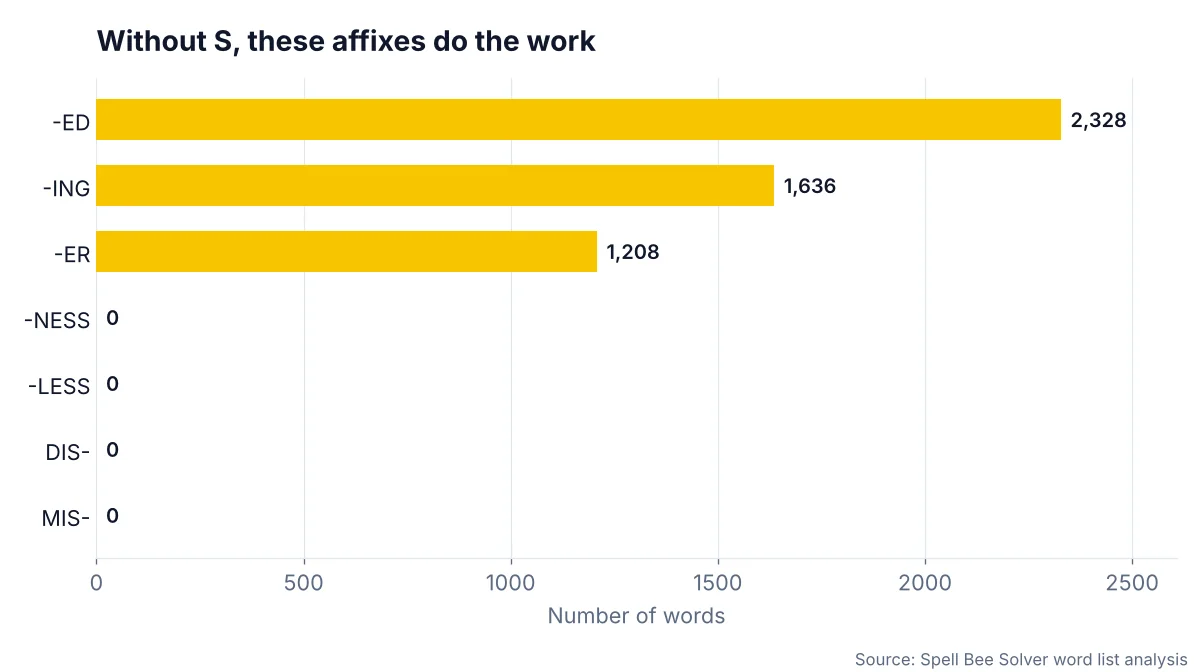
Leaving out S does more than block plurals. In our answer list of 16,662 words, these patterns produced zero answers:
- plurals ending in -S and -ES
- -NESS words (KINDNESS, DARKNESS)
- -LESS words (CARELESS, HOPELESS)
- DIS- and MIS- words (DISLIKE, MISTAKE)
- third-person verbs (RUNS, PLAYS)
That’s a big chunk of English that you never have to think about.
What it pushes you toward
With S gone, other endings do the heavy lifting. The top three in our list:
| Ending | Words |
|---|---|
| -ED | 2,298 |
| -ING | 1,611 |
| -ER | 1,190 |
So when you’re tempted to add S, add -ED, -ING or -ER instead. Our prefix and suffix cheat sheet has the full ranking.
Does Spell Bee Solver follow the rule?
Yes. Every hive in Spelling Bee Unlimited, including the daily puzzle, is built without S, and our word list leaves out S words entirely. That keeps the puzzles close to the classic format.
If you enter letters with S into the Spelling Bee Solver, you’ll find no words containing it, so it works best with real puzzle letters.
The bottom line
No S means no cheap plurals, more interesting word lists, and more weight on endings like -ED and -ING. Once you stop reaching for S, you’ll find words faster. Put it into practice with our step-by-step Spelling Bee strategy.
Frequently asked questions
Why is there no S in Spelling Bee?
Including S would let players add it to almost any word to make a plural, which would make puzzles much easier and flood the answer list with near-duplicate words.
Has the NYT Spelling Bee ever used the letter S?
Yes, but very rarely. Reported exceptions include the 2,500th puzzle on 12 March 2025, plus puzzles on 2 September 2025 and 29 May 2026.
Does Spell Bee Solver ever use S?
No. Every Spell Bee Solver hive is built without S, so plurals and words like -NESS or -LESS never appear.
Keep reading
Spelling Bee Scoring and Ranks Explained (Full Rank List)
How Spelling Bee scoring works: points per word, the pangram bonus, and every rank from Beginner to Queen Bee with the percentage of points each one needs.
How to Play Spelling Bee: Rules, Scoring and Tips for Beginners
What is Spelling Bee and how do you play it? The rules, scoring, ranks and five beginner tips, with a worked example. Play free online, no login.
NYT Spelling Bee History: From Print Puzzle to Daily Habit
How the NYT Spelling Bee started: its 2015 print debut, the 2018 digital launch, the people behind it, the no-S rule and how unlimited versions grew from it.