Spelling Bee Strategy: A Step-by-Step Guide to Reach Genius
A proven Spelling Bee strategy in 6 steps: scan the hive, build word families, find the pangram and reach Genius faster. Based on data from 500 puzzles.
Key takeaways
- Work in a fixed order: short words, then endings, then the pangram, then a letter-by-letter sweep.
- Long words carry the score: 6+ letter words earn about two-thirds of all points.
- Genius (70% of points) is reachable with about 45% of the words if you find the longest first.
- Use hints only at the end, starting with the two-letter list.
Most players plateau not because their vocabulary is too small, but because they search the hive at random. A repeatable Spelling Bee strategy fixes that. The six steps below are the routine our team uses every morning, and they’re shaped by data from 500 puzzles generated in our own game.
Quick version: short words first → endings → pangram → letter-by-letter sweep → shuffle and rest → hints only at the end.
Know what you’re aiming for
Before you type a single word, it helps to know the shape of an average puzzle. Across our 500-puzzle sample:
| Stat | Average |
|---|---|
| Words per puzzle | 54 (range 20–90) |
| Maximum score | 244 points |
| Share of 4-letter words | 37% |
| Puzzles with more than one pangram | 29% |
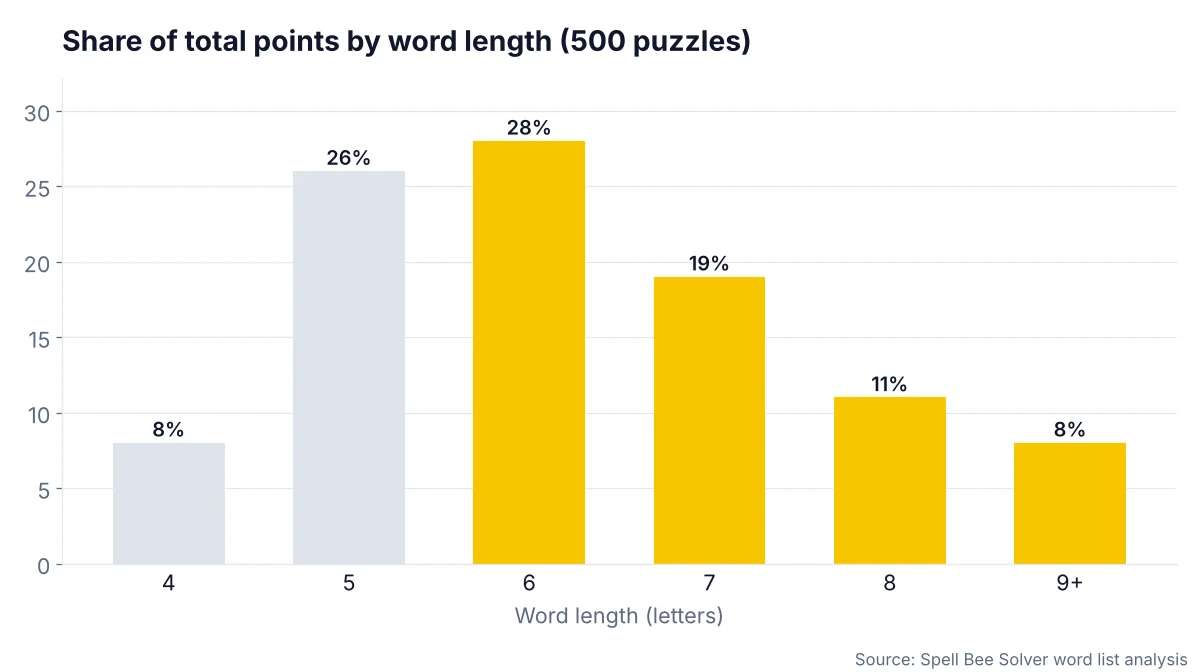
Two things jump out. First, more than a third of the answers are 4-letter words worth just 1 point each. Second, long words carry the score. That’s why Genius (about 70% of the maximum) was reachable with only about 45% of the words when the longest ones were found first. Read how Spelling Bee scoring works for the full rank table.
Step 1: Bank the short words with the center letter
Start by pairing the center letter with each outer letter and say the combinations out loud. If the center is A and the outer letters include R, T and Y, you’ll quickly find ARTY, TART and TRAY.
Don’t stop to hunt for anything clever yet. The goal of the first two minutes is momentum. Every quick find primes your memory for the longer words that use the same letters.
Step 2: Test the endings that pay
Once you have a handful of base words, add endings. In our answer list of more than 16,700 words, these suffixes appear most often:
- -ED (2,298 words)
- -ING (1,611 words)
- -ER (1,190 words)
- -LY (409 words)
- -AL (395 words)
If the hive contains E and D, every verb you’ve found is a candidate for -ED. If it has I, N and G, try -ING on everything. One base word can easily turn into three or four answers. Our prefix and suffix cheat sheet lists the full set.
Step 3: Hunt the pangram early
The pangram is worth its length plus 7 bonus points, so a 7-letter pangram scores 14 on its own. Finding it early also gives your rank a visible jump, which keeps motivation up.
Look at the vowels first, then try common chunks: -TION, -ING, -MENT, -ABLE. If the letters include I, N and G, the pangram very often ends in -ING. We break down seven methods in how to find the pangram.
Step 4: Sweep letter by letter
This is where most of the missing points are. Pick the first outer letter and ask: what words start with this letter and include the center letter? Then move to the next letter. Repeat for every letter in the hive, including the center.
Doing it in order stops you from rechecking the same patterns. It also shows you where the gaps are: if you have eight words starting with T and none starting with M, that’s where to look.
Step 5: Shuffle, then walk away
Our brains lock onto the first arrangement of letters they see. Pressing Shuffle breaks that lock and often reveals a word that was hiding in plain sight. Shuffle two or three times in a row, reading the outer ring clockwise each time.
When shuffling stops working, take a break. Ten minutes away from the hive does more than another ten minutes staring at it. If you’re stuck one rank below your goal, read how to break the Amazing plateau.
Step 6: Use hints as a last step, not a first one
Hints are most useful when you already have most of the words. The two-letter list (“TR-3, MA-2”) tells you exactly where your remaining words begin without giving them away. Save it for the final stretch, and only open the full Spelling Bee Solver when you’ve decided you’re done.
A 15-minute routine you can copy
- Minutes 0–3: short words with the center letter
- Minutes 3–6: add -ED, -ING, -ER and -LY to everything
- Minutes 6–9: pangram hunt
- Minutes 9–15: letter-by-letter sweep, shuffle when stuck
- Later: come back once, then check hints
Try the routine on a fresh board in Spelling Bee Unlimited. Because there’s no daily cap, you can practise each step until it’s automatic.
Frequently asked questions
What is the best strategy for Spelling Bee?
Work in a fixed order: bank short words with the center letter, test common endings like -ED, -ING and -ER, look for the pangram early, then go letter by letter through every possible starting letter.
How many words do you need for Genius in Spelling Bee?
Genius is about 70% of the maximum points. In our analysis of 500 puzzles, finding the longest words first meant Genius was reachable with roughly 45% of the word list.
Should I play Spelling Bee fast or slow?
Short sessions work better than one long one. Play for 10 to 15 minutes, take a break, and come back. Fresh eyes find words that a tired brain skips.
Keep reading
How to Find the Pangram in Spelling Bee: 7 Methods That Work
What a Spelling Bee pangram is, how much it scores, and 7 practical methods to find it fast, backed by an analysis of 4,397 pangrams.
How to Get Queen Bee in Spelling Bee (Find Every Last Word)
Queen Bee means finding every word in the puzzle. Learn where the last words hide, the repeated-letter trick, and a clean-up routine to finish the hive.
Stuck at Amazing? How to Reach Genius in Spelling Bee
Why so many players stall at Amazing rank in Spelling Bee, and 6 practical ways to close the gap to Genius. Includes the average points gap from 500 puzzles.