How to Find the Pangram in Spelling Bee: 7 Methods That Work
What a Spelling Bee pangram is, how much it scores, and 7 practical methods to find it fast, backed by an analysis of 4,397 pangrams.
Key takeaways
- A pangram uses all 7 letters at least once and scores its length plus 7.
- One pangram in three ends in -ING or -ED, so check those first.
- 92% of pangrams have two or three vowels; build the word around them.
- 29% of puzzles have more than one pangram.
Every Spelling Bee puzzle hides at least one pangram: a word that uses all seven letters. It’s the single most valuable word on the board, and finding it early changes the whole game. Here’s what the data says about pangrams, and seven methods to find them.
What counts as a pangram?
A pangram uses every letter in the hive at least once. Repeats are allowed, so a pangram can be longer than seven letters. When each letter appears exactly once, players call it a perfect pangram.
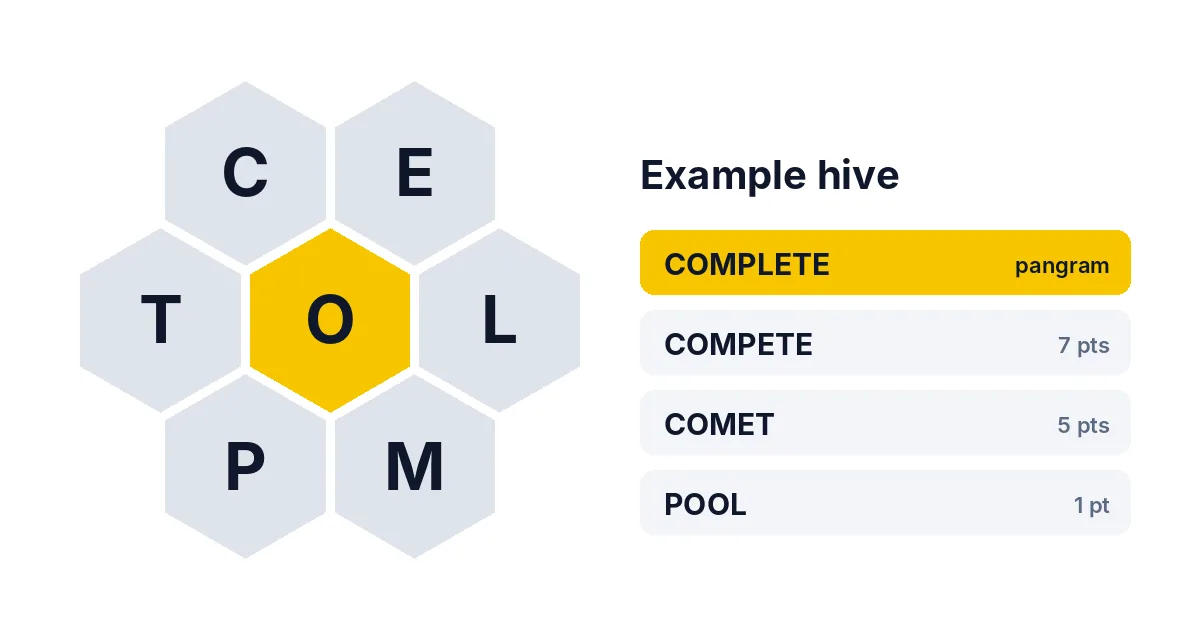
Scoring is simple: the word’s normal points (one per letter) plus 7. A 7-letter pangram scores 14, an 8-letter one scores 15. For the full point and rank system, see Spelling Bee scoring and ranks explained.
What 4,397 pangrams tell us
We analysed every pangram in our answer list (4,397 words) and the puzzles built from them:
| Finding | Result |
|---|---|
| Most common pangram length | 8 letters (32%) |
| Perfect 7-letter pangrams | 27% |
| Pangrams with 2 or 3 vowels | 92% |
| Puzzles with more than one pangram | 29% |
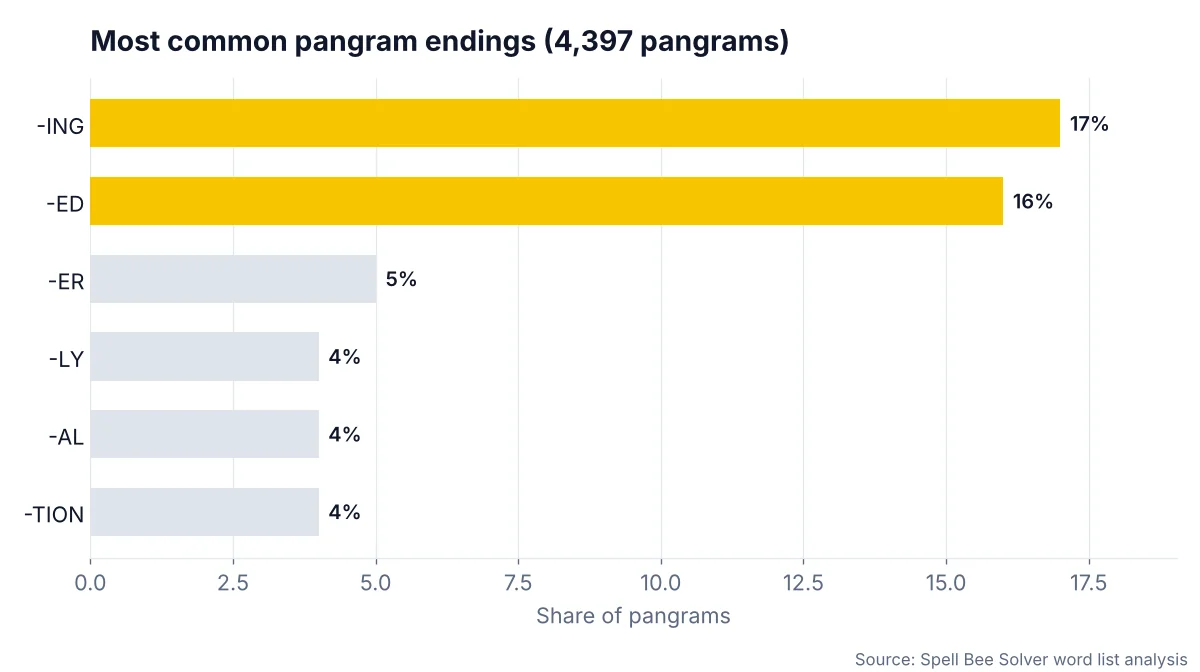
And the endings that show up most:
| Ending | Share of pangrams |
|---|---|
| -ING | 17% |
| -ED | 16% |
| -ER | 5% |
| -LY | 4% |
| -AL | 4% |
| -TION | 4% |
Put simply: one pangram in three ends in -ING or -ED. That single fact is the most useful pangram tip there is.
Method 1: Check for -ING and -ED first
If the hive contains I, N and G, assume the pangram ends in -ING until proven otherwise. Take the four remaining letters and try to make a verb from them. The same goes for E and D: look for a verb that uses the other five letters, then add -ED.
Method 2: Count the vowels
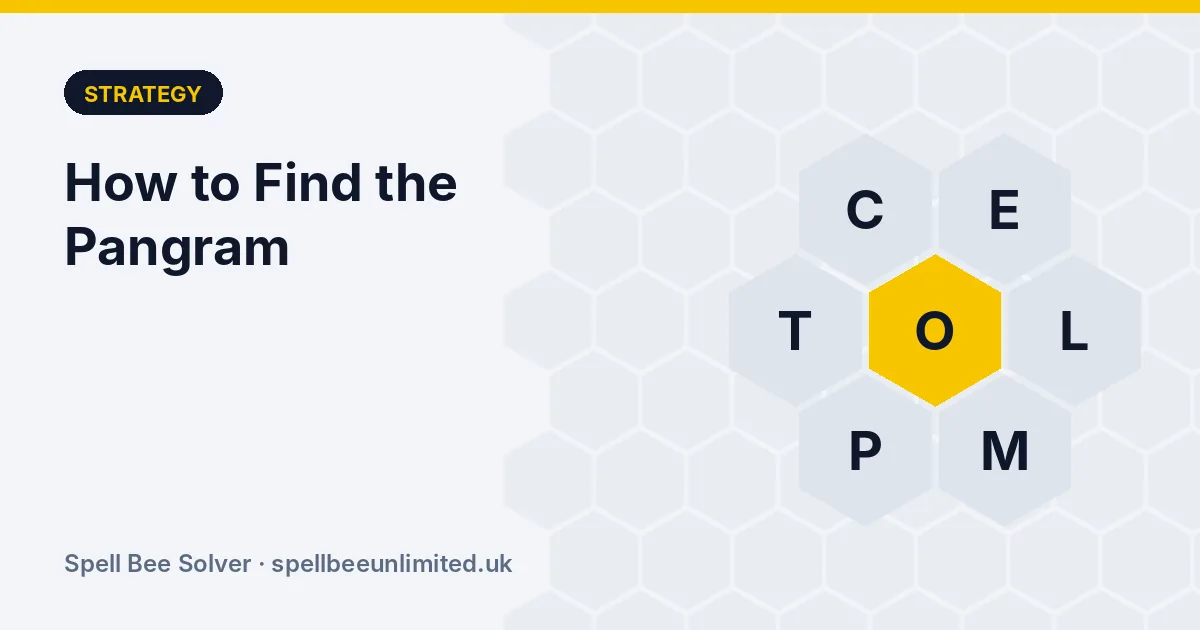
Since 92% of pangrams have two or three vowels, the vowels form the skeleton of the word. Write the consonants in a row and try slotting the vowels between them. A hive like C, L, M, O, P, E, T gives you O and E to work with: COMPLETE appears quickly once you place them.
Method 3: Build from the rarest letters
Letters like J, Q, X, Z, K and V limit what’s possible. If the hive has one, list every word you know that uses it. The pangram has to contain that letter, so a short list of candidates is a big head start.
Method 4: Look for common chunks
Beyond endings, watch for chunks that pack several letters at once: -TION, -MENT, -ABLE, -OUGH, PRE-, CON-, UN-. If the hive holds T, I, O and N, try -TION words straight away.
Method 5: Extend words you’ve already found
Your longest finds are often one or two letters away from the pangram. If you have CLAIM and the other two letters are N and G, CLAIMING is sitting right there. Always ask: which letters have I not used yet?
Method 6: Shuffle with a purpose
Pressing Shuffle is more useful when you read the outer ring as one word each time. Shuffle, read clockwise, shuffle again. Your brain spots letter pairs it missed in the old layout.
Method 7: Use a pangram-only hint
If you’re truly stuck, don’t open the full answer list. Our Spelling Bee Solver has a Hints only mode that tells you how many pangrams exist and the word lengths, without revealing the words. Knowing it’s 8 letters long is often enough.
When to look for it
Look for the pangram after your first few short words, not before. A few quick finds warm up your memory for those letters. Then switch to the methods above. If you’re working on a full routine, our step-by-step Spelling Bee strategy shows where the pangram fits.
Want practice? Every board in Spelling Bee Unlimited has at least one pangram, and you can start a new one as soon as you find it.
Frequently asked questions
What is a pangram in Spelling Bee?
A pangram is a word that uses all seven letters of the hive at least once. Letters can repeat, so the word can be longer than seven letters.
How many points is a pangram worth?
A pangram scores one point per letter plus a 7-point bonus. A 7-letter pangram is worth 14 points; an 8-letter pangram is worth 15.
Does every Spelling Bee puzzle have a pangram?
Yes. Every puzzle is built around at least one pangram. In our sample of 500 puzzles, 29% had two or more.
What is a perfect pangram?
A perfect pangram uses each of the seven letters exactly once, so it is exactly seven letters long. About 27% of the pangrams in our word list are perfect.
Keep reading
Spelling Bee Strategy: A Step-by-Step Guide to Reach Genius
A proven Spelling Bee strategy in 6 steps: scan the hive, build word families, find the pangram and reach Genius faster. Based on data from 500 puzzles.
How to Get Queen Bee in Spelling Bee (Find Every Last Word)
Queen Bee means finding every word in the puzzle. Learn where the last words hide, the repeated-letter trick, and a clean-up routine to finish the hive.
Stuck at Amazing? How to Reach Genius in Spelling Bee
Why so many players stall at Amazing rank in Spelling Bee, and 6 practical ways to close the gap to Genius. Includes the average points gap from 500 puzzles.