Stuck at Amazing? How to Reach Genius in Spelling Bee
Why so many players stall at Amazing rank in Spelling Bee, and 6 practical ways to close the gap to Genius. Includes the average points gap from 500 puzzles.
Key takeaways
- Amazing is 50% of the maximum score; Genius is 70%.
- The gap averages 49 points, so close it with long words, not 4-letter words.
- Extend words you already have with -ED, -ING, -ER and -LY.
- A second pangram can cover a third of the gap on its own.
You’ve found the easy words, the pangram, and a good chunk of the rest. The rank says Amazing. Then nothing. If that sounds familiar, you’re not alone: Amazing is the most common place for a game to stall. Here’s why it happens and how to break through.
Why Amazing is a wall
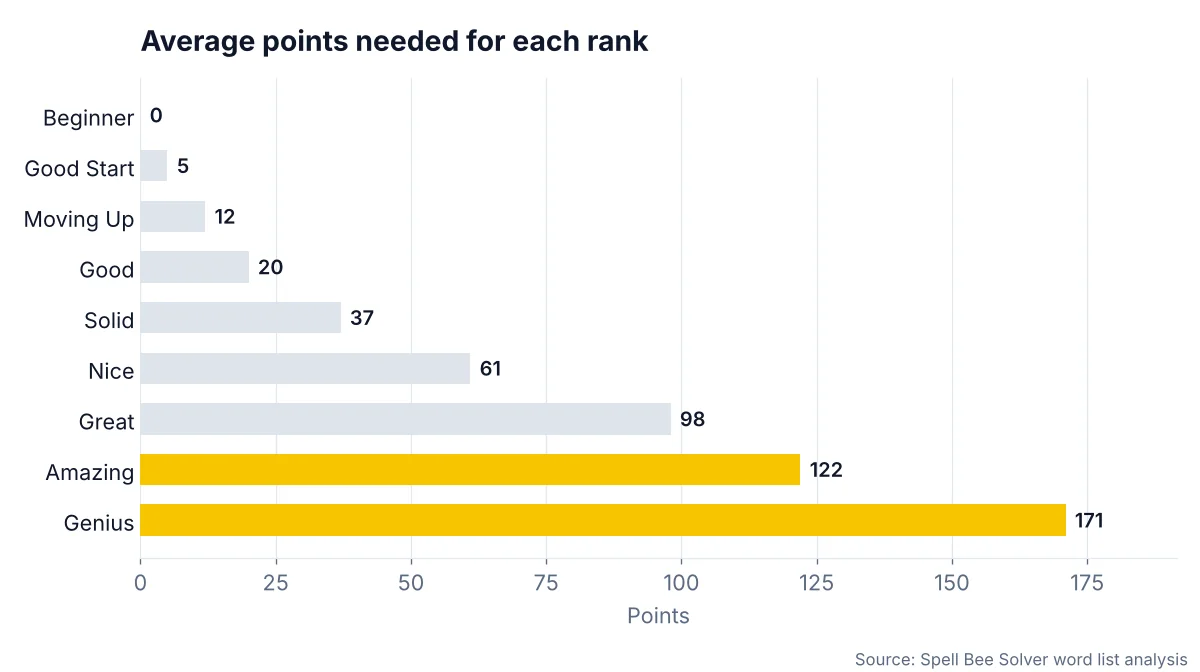
Amazing starts at 50% of the puzzle’s maximum score. Genius starts at 70%. Across 500 puzzles in our game, that gap averaged 49 points.
Forty-nine points sounds like a lot, but remember how scoring works: a 4-letter word is worth 1 point, while a 7-letter word is worth 7. If you close the gap with 4-letter words, you need dozens. With 6- and 7-letter words, you need seven or eight. The fix for Amazing is almost always longer words, not more words.
1. Stop hunting 4-letter words
By Amazing, your brain is in “short word” mode. Switch it off. Spend the next five minutes looking only for words of six letters or more. Every one you find is worth at least six times a 4-letter word.
2. Stretch the words you already have
Your found list is a goldmine. Go down it and add endings: -ED, -ING, -ER, -LY. TRAIN becomes TRAINED, TRAINER, TRAINING when the letters allow. Each extension is a long word worth many points. Our prefix and suffix cheat sheet ranks the endings that work most often.
3. Find a second pangram
29% of puzzles in our sample had more than one pangram. Each one is worth its length plus 7, so a second pangram can cover a third of the gap on its own. If the hint panel says there’s more than one, it’s the best use of your next ten minutes. Use the methods in how to find the pangram.
4. Sweep by starting letter
Write the seven letters down and give yourself one minute per letter: “What long words start with T?” Then the next letter. Doing it in order stops your brain from circling the same patterns, and it shows you which letters you’ve ignored.
5. Change the view
The hive layout steers your eyes. Press Shuffle three times and read the outer ring as if it were a word each time. Or step away completely. A ten-minute break resets your attention, and many players find two or three words in the first minute back.
6. Use the two-letter hint, not the answers
If you want help, use the smallest hint that works. The two-letter list tells you, for example, that there are three words starting with “TR” you haven’t found. That’s enough to focus your search without spoiling it. The Hints only mode in our Spelling Bee Solver shows this without revealing a single word.
What not to do
- Don’t guess random letter strings. It’s slow and breaks your concentration.
- Don’t play for an hour straight. Two 15-minute sessions beat one long one.
- Don’t chase 1-point words until you’re past Genius.
Make it a habit
Breaking the Amazing wall gets easier with practice. Play a few boards in Spelling Bee Unlimited and use only steps 1–3 until you’ve hit Genius without hints. Then build the rest into your full Spelling Bee strategy. And when Genius gets easy, the next goal is Queen Bee.
Frequently asked questions
How many points between Amazing and Genius?
Amazing starts at 50% of the maximum score and Genius at 70%. In our 500-puzzle sample, that gap averaged 49 points.
Why do I always get stuck at Amazing?
By Amazing you've found the easy words. The rest need a change of approach: longer words, endings on words you already have, and a systematic letter-by-letter sweep.
Is it cheating to use hints to reach Genius?
It's your game. Two-letter hints point you to the right area without revealing words, which many players see as fair.
Keep reading
Spelling Bee Strategy: A Step-by-Step Guide to Reach Genius
A proven Spelling Bee strategy in 6 steps: scan the hive, build word families, find the pangram and reach Genius faster. Based on data from 500 puzzles.
How to Find the Pangram in Spelling Bee: 7 Methods That Work
What a Spelling Bee pangram is, how much it scores, and 7 practical methods to find it fast, backed by an analysis of 4,397 pangrams.
How to Get Queen Bee in Spelling Bee (Find Every Last Word)
Queen Bee means finding every word in the puzzle. Learn where the last words hide, the repeated-letter trick, and a clean-up routine to finish the hive.