NYT Spelling Bee History: From Print Puzzle to Daily Habit
How the NYT Spelling Bee started: its 2015 print debut, the 2018 digital launch, the people behind it, the no-S rule and how unlimited versions grew from it.
Key takeaways
- The NYT Spelling Bee was developed by Frank Longo after a proposal by Will Shortz.
- It started in print on 22 February 2015 and went daily online on 9 May 2018.
- Sam Ezersky edits the puzzle; S has been excluded since 2021 with rare exceptions.
- Independent Spelling Bee Unlimited games grew from demand for more than one puzzle a day.
Today the honeycomb of seven letters is one of the most recognisable word puzzles in the world. It started much more quietly. Here’s how the NYT Spelling Bee went from a weekly magazine puzzle to a daily habit for millions, and how unlimited versions grew around it.
A British inspiration
The idea traces back to Will Shortz, the New York Times crossword editor. He was inspired by Polygon, a letter puzzle in The Times of London, and proposed a similar game. Puzzle constructor Frank Longo developed it into the format players know today.
2015: a weekly print puzzle
The Spelling Bee first appeared in print in The New York Times Magazine on 22 February 2015, as a weekly feature. The basic rules were already there: seven letters, one required center letter, and words of a minimum length that could reuse letters.
2018: the digital daily
The big change came on 9 May 2018, when the Spelling Bee launched as a daily digital puzzle with updated scoring. Sam Ezersky became its editor for the digital debut and has shaped it since.
The digital version introduced the features most players now think of as “Spelling Bee”:
- a new puzzle every day, released at 3 a.m. Eastern Time
- one point for 4-letter words and one point per letter for longer words
- a 7-point bonus for the pangram
- ranks that rise as you score, up to Genius and the all-words Queen Bee
We explain every rank in Spelling Bee scoring and ranks explained.
The no-S rule
In 2021, Ezersky said the puzzle would not include the letter S, because plurals would make the game too easy. A handful of exceptions have been made since, including the 2,500th puzzle on 12 March 2025. Read the full story in why there’s no S in Spelling Bee.
The lockdown boom
The game’s popularity jumped during the COVID-19 lockdowns, when many people turned to daily puzzles as a calm routine. A large community grew on social media, sharing ranks and debating which words should or shouldn’t count. Fan-made hint tools and analysis sites became part of the ritual.
Adaptations around the world
The format travelled. Paraulògic, a Catalan adaptation, launched in November 2021 and went viral in Catalonia. An Albanian version, Germëzhimë, followed in 2024. Each one adapted the same core idea to its own language.
Why unlimited versions exist
The daily format has one limit: one puzzle per day. Many players finish quickly and want more, or want to practise without waiting. That demand led to independent Spelling Bee Unlimited games, like ours, that use the same honeycomb rules but let you start a new puzzle whenever you want. Compare both styles in Daily vs Spelling Bee Unlimited.
Timeline at a glance
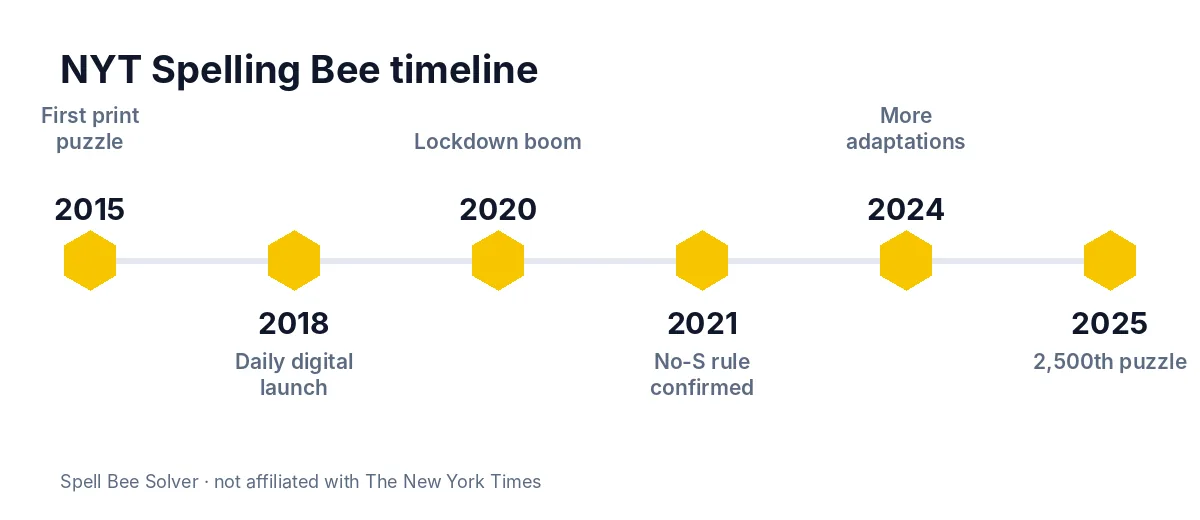
| Year | Moment |
|---|---|
| 2015 | First print puzzle in The New York Times Magazine (22 February) |
| 2018 | Daily digital version launches (9 May) |
| 2020 | Popularity surges during lockdowns |
| 2021 | Editor confirms the no-S rule; Paraulògic launches |
| 2024 | Albanian adaptation Germëzhimë appears |
| 2025 | 2,500th puzzle, a rare S exception (12 March) |
Spell Bee Solver is an independent game and isn’t affiliated with The New York Times. If you’d like to play the format without a daily cap, start a puzzle in Spelling Bee Unlimited.
Sources: >The New York Times Spelling Bee on Wikipedia.
Frequently asked questions
Who created the NYT Spelling Bee?
The puzzle was developed by Frank Longo after a proposal from Will Shortz, who was inspired by a puzzle called Polygon in The Times of London.
When did the NYT Spelling Bee start?
It first appeared in print in The New York Times Magazine on 22 February 2015, and the daily digital version launched on 9 May 2018.
Who edits the NYT Spelling Bee?
Sam Ezersky has edited the puzzle since its digital debut.
Is Spelling Bee Unlimited made by the New York Times?
No. Spelling Bee Unlimited on Spell Bee Solver is an independent game that uses the same honeycomb format. It isn't affiliated with The New York Times.
Keep reading
Why Is There No S in Spelling Bee? The Rule Explained
Why the letter S almost never appears in Spelling Bee, what the editor said about it, the rare exceptions, and how the rule changes the words you can play.
Daily vs Spelling Bee Unlimited: Which Mode Should You Play?
Daily Spelling Bee or Spelling Bee Unlimited? Compare both modes on practice value, streaks, social play and time, and find a weekly routine that uses both.
How to Play Spelling Bee: Rules, Scoring and Tips for Beginners
What is Spelling Bee and how do you play it? The rules, scoring, ranks and five beginner tips, with a worked example. Play free online, no login.